
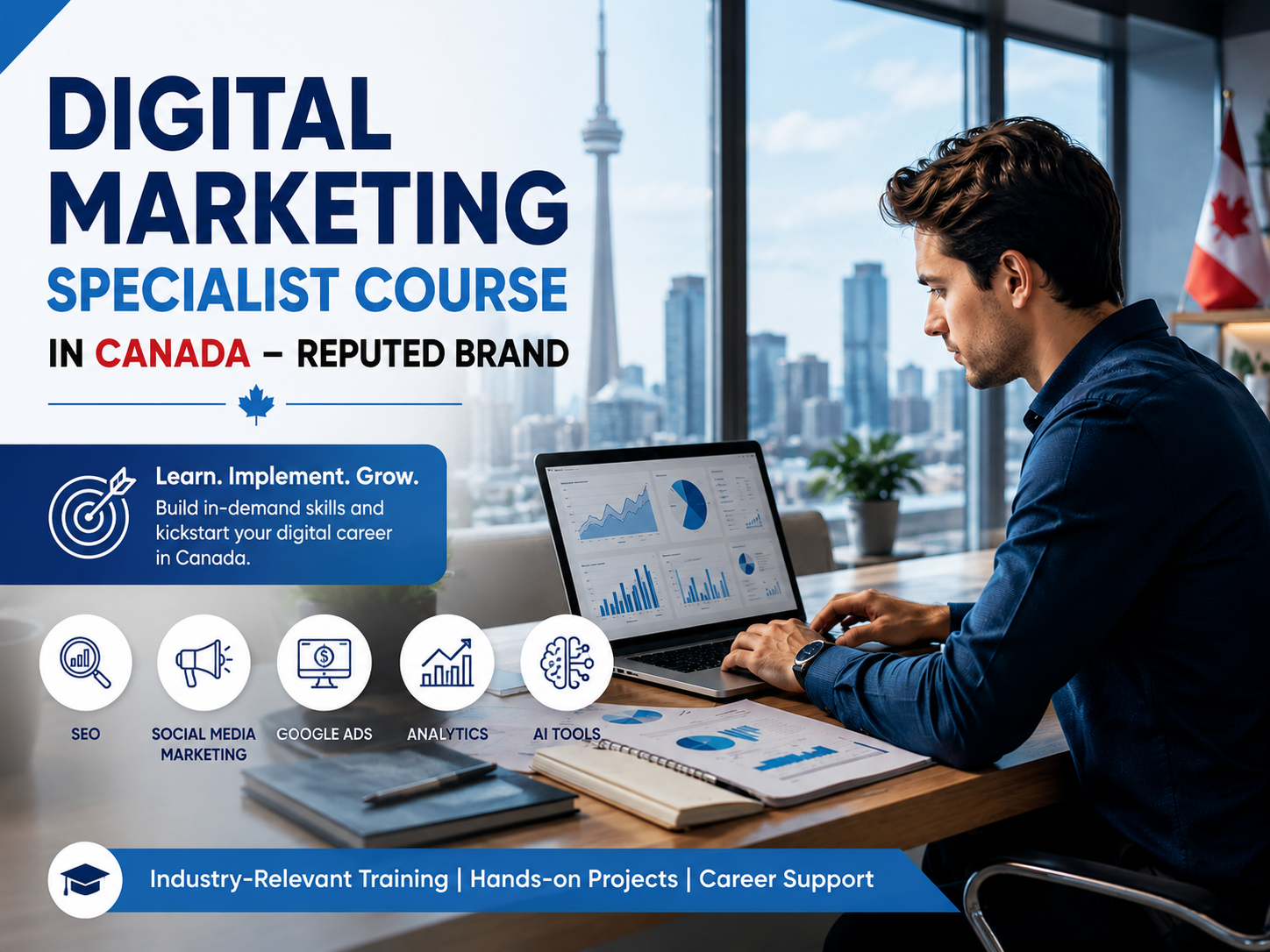
Digital marketing has become an essential part of how businesses attract customers, build brand awareness, generate leads, and increase online sales. As Canadian businesses continue to invest in search, social media, paid advertising, content, analytics, and e-commerce, professionals with practical digital marketing skills can find opportunities across a wide range of industries.
A Digital Marketing Specialist Course in Canada from a reputed brand can help students, working professionals, entrepreneurs, freelancers, and career changers develop the knowledge needed to work with modern digital channels. Professional programs in Canada commonly cover areas such as SEO, paid search, social media, content marketing, analytics, and e-commerce.
What Is a Digital Marketing Specialist Course?
A Digital Marketing Specialist Course is a professional training program designed to teach learners how businesses use digital channels to reach and convert their target audiences.
Unlike a course that focuses only on marketing theory, a specialist-level program can introduce learners to practical areas such as:
- Search Engine Optimization (SEO)
- Search Engine Marketing (SEM)
- Google Ads and PPC advertising
- Social media marketing
- Content marketing
- Email marketing
- Website and conversion optimization
- Google Analytics and marketing analytics
- E-commerce marketing
- Online reputation and brand management
- AI-assisted digital marketing
The exact curriculum depends on the institution or training provider. For example, Canadian programs from Google, Douglas College, McMaster Continuing Education, and other providers include combinations of SEO, paid advertising, social media, analytics, content, and e-commerce.
Why Choose a Digital Marketing Course in Canada?
Canada has a diverse business ecosystem that includes startups, technology companies, retail brands, professional services, agencies, e-commerce businesses, and large organizations. Almost every industry needs an online presence, creating demand for people who understand digital marketing strategy and execution.
A good digital marketing course in Canada can help learners develop skills that are useful across different industries rather than limiting them to one specific business sector.
Professional training can also help learners understand how to plan campaigns, identify target audiences, measure performance, and make data-driven marketing decisions.
What You Can Learn in a Digital Marketing Specialist Course
Search Engine Optimization
SEO is one of the most important components of digital marketing. Students can learn how search engines work and how websites can improve their organic visibility.
A comprehensive SEO module may cover:
- Keyword research
- On-page SEO
- Technical SEO
- Content optimization
- Internal linking
- Local SEO
- Off-page SEO
- Link building
- Search performance analysis
SEO skills can be useful for businesses that want to generate sustainable organic traffic without depending entirely on paid advertising.
Google Ads and PPC Marketing
Paid advertising allows businesses to reach potential customers more quickly through search engines and other advertising platforms.
A specialist course may introduce:
- Search campaigns
- Display advertising
- Keyword targeting
- Audience targeting
- Ad copy
- Conversion tracking
- Campaign optimization
- Performance measurement
Canadian digital marketing programs commonly include paid search and advertising as part of their curriculum.
Social Media Marketing
Social media has become an important channel for brand communication and customer engagement.
Students can learn how to develop social media strategies, create content calendars, understand audiences, manage campaigns, and measure engagement and conversions.
Depending on the program, training may cover platforms such as Instagram, Facebook, LinkedIn, YouTube, TikTok, and other relevant social networks.
Content Marketing
Content is at the centre of many successful digital marketing strategies. A course can teach students how to create content based on search intent, customer needs, brand objectives, and different stages of the buying journey.
Topics may include:
- Blog content
- Website copy
- Social media content
- Video content
- Content strategy
- Content distribution
- Conversion-focused copywriting
- AI-assisted content workflows
Analytics and Performance Marketing
Learning how to measure marketing performance is just as important as learning how to create campaigns.
Students may work with analytics platforms and learn how to understand metrics such as:
- Website traffic
- Leads
- Conversions
- Click-through rate
- Engagement
- Cost per acquisition
- Return on advertising spend
- Campaign performance
Google’s Canadian Digital Marketing & E-commerce Certificate, for example, includes marketing analytics and measurement alongside practical digital marketing and e-commerce skills.
Why Practical Training Matters
One of the most important factors to consider when choosing a Digital Marketing Specialist Course in Canada is practical exposure.
Digital marketing changes quickly. Knowing definitions and concepts is useful, but employers and clients also value the ability to apply those concepts to real marketing situations.
Some Canadian programs include hands-on activities, projects, client work, practicums, or co-op opportunities. Douglas College, for example, highlights practical experience with a real-world client, while other Canadian programs include practicum or co-op components.
When comparing reputed brands, look for a program that provides opportunities to:
- Work on practical campaigns.
- Perform keyword research.
- Create SEO strategies.
- Build advertising campaigns.
- Develop social media plans.
- Analyse marketing data.
- Prepare professional reports.
- Build a portfolio of projects.
Who Should Take a Digital Marketing Specialist Course?
A digital marketing specialist program can be suitable for different types of learners.
Students and Fresh Graduates
Students can develop an additional professional skill set that complements their academic qualification. Digital marketing knowledge can be useful when applying for entry-level marketing positions.
Working Professionals
Professionals from sales, communications, business development, advertising, public relations, and traditional marketing can use digital marketing training to expand their existing skills.
Career Changers
People looking to move into marketing or technology-related roles can use structured digital marketing training to build foundational knowledge and practical capabilities.
Entrepreneurs and Small Business Owners
Business owners can learn how to promote their websites, products, and services using SEO, social media, paid advertising, email marketing, and content strategies.
Freelancers
Freelancers can develop services such as SEO, social media management, Google Ads, content marketing, and digital strategy for clients.
Career Opportunities After Digital Marketing Training
A specialist-level digital marketing education can prepare learners for a variety of marketing-related roles.
Possible career paths include:
- Digital Marketing Specialist
- Digital Marketing Coordinator
- SEO Specialist
- SEO Analyst
- PPC Specialist
- Google Ads Specialist
- Social Media Specialist
- Content Marketing Specialist
- Email Marketing Specialist
- E-commerce Specialist
- Digital Marketing Analyst
- Marketing Coordinator
- Digital Marketing Manager
Canadian educational programs list similar career pathways, including Digital Marketing Specialist, Marketing Coordinator, Social Media Manager, Digital Marketing Analyst, Content Marketing Manager, and Digital Marketing Manager.
How to Choose a Reputed Digital Marketing Brand in Canada
Choosing the right training provider is important because the quality of learning can significantly affect your professional development.
Before enrolling, consider the following factors.
Industry-Relevant Curriculum
Look for a curriculum that covers current digital marketing channels, including SEO, PPC, social media, content marketing, analytics, and e-commerce.
Experienced Trainers
Experienced instructors can provide practical insights that go beyond textbook concepts. Check the trainers’ professional background and industry experience.
Practical Projects
A reputed course should ideally provide opportunities to work on realistic marketing projects instead of focusing exclusively on theoretical lessons.
Certifications
Industry-recognized certifications can strengthen your professional profile. Some Canadian programs prepare learners for certifications from organizations or platforms such as Google, Hootsuite, and the Digital Marketing Institute.
Flexible Learning Options
Online, in-person, hybrid, evening, and weekend formats can make professional training easier to manage alongside work or education.
Career Support
If your goal is employment, investigate whether the provider offers portfolio development, interview preparation, career guidance, networking, or placement assistance.
Digital Marketing and AI
Artificial intelligence is becoming increasingly relevant to modern marketing workflows.
AI can help marketers with tasks such as research, ideation, content variations, audience analysis, campaign planning, and data interpretation. However, marketers still need human judgment to evaluate information, understand customers, maintain brand voice, and make strategic decisions.
Google’s Digital Marketing & E-commerce Certificate has also incorporated AI training focused on areas such as marketing strategy, market research, campaign decisions, and content generation.
Therefore, when selecting a Digital Marketing Specialist Course in Canada, consider whether the curriculum teaches students how to use AI responsibly alongside fundamental marketing skills.
Online vs In-Person Digital Marketing Courses
Both learning formats can be effective.
Online Digital Marketing Course
Online learning can provide flexibility for students, professionals, entrepreneurs, and people managing other commitments. Some Canadian programs are completely online or offer online delivery.
In-Person Digital Marketing Course
Classroom learning can provide direct interaction with instructors and other learners. It may be particularly useful for students who prefer structured schedules and face-to-face guidance.
Hybrid Learning
Hybrid programs combine online learning with classroom or practical components, providing a balance between flexibility and direct interaction.
The best format depends on your schedule, learning preferences, budget, and career objectives.
Benefits of Becoming a Digital Marketing Specialist
A strong digital marketing skill set can offer several professional advantages:
- Multiple career paths
- Skills applicable across industries
- Opportunities to work with businesses of different sizes
- Potential for freelance work
- Ability to support your own business
- Remote and flexible work possibilities in some roles
- Continuous learning opportunities
- Exposure to marketing technology and AI
Digital marketing is also a field where professionals can continue developing their expertise as platforms, consumer behaviour, search technologies, advertising systems, and AI tools evolve.
Build a Digital Marketing Portfolio
Completing a course is only one part of becoming a strong digital marketing professional. Building a portfolio can help demonstrate what you can actually do.
Your portfolio could include:
- SEO audits
- Keyword research projects
- Content strategies
- Sample Google Ads campaigns
- Social media calendars
- Website optimization recommendations
- Analytics reports
- E-commerce marketing plans
- Case studies
A portfolio can make your skills easier for employers and clients to evaluate.
Final Thoughts
A Digital Marketing Specialist Course in Canada from a reputed brand can be a valuable step for anyone who wants to build a career in modern marketing. The strongest programs combine digital marketing fundamentals with practical training in SEO, PPC, social media, content, analytics, e-commerce, and emerging AI applications.
When comparing courses, don’t choose solely on the basis of price or course duration. Evaluate the curriculum, trainer expertise, practical projects, certifications, learning format, career support, and opportunities to build a professional portfolio.
With the right training and consistent hands-on practice, learners can develop a versatile digital marketing skill set that can support careers, freelance opportunities, entrepreneurship, and long-term professional growth.
Frequently Asked Questions
What is a Digital Marketing Specialist Course in Canada?
It is a professional training program covering digital channels such as SEO, paid advertising, social media, content marketing, analytics, email marketing, and e-commerce.
Is digital marketing a good career option in Canada?
Digital marketing offers multiple career paths across industries. Canadian educational institutions list roles such as Digital Marketing Specialist, SEO/SEM Specialist, Social Media Manager, Digital Marketing Analyst, and Digital Marketing Manager among potential career opportunities.
Can beginners learn digital marketing?
Yes. Several introductory programs are designed for learners without previous digital marketing experience. Google’s Canadian Digital Marketing & E-commerce Certificate, for example, states that no previous experience is required.
What skills should a digital marketing specialist have?
Important skills include SEO, PPC advertising, social media marketing, content strategy, analytics, communication, audience research, conversion optimization, and an understanding of digital marketing tools.
Should I choose an online or classroom course?
Both can work well. Choose based on your schedule, preferred learning style, location, budget, and the amount of practical support offered by the training provider.
Does a digital marketing course guarantee a job?
No legitimate course can guarantee employment. A course can provide knowledge, skills, projects, and credentials, but employment also depends on your experience, portfolio, communication skills, qualifications, and the requirements of individual employers.
How long does a digital marketing course take?
Duration varies considerably. Some certificates can be completed in a few months, while college diploma and extended professional programs can take considerably longer.
Disclaimer
Course availability, curriculum, certifications, fees, admission requirements, career outcomes, and program formats can change. Always verify the latest information directly with the training provider before enrolling. Career opportunities are not guaranteed and depend on individual qualifications, experience, portfolio, location, and employer requirements.

Leave a Reply